
At Udall Road Middle School in West Islip, we recently had the opportunity to lead a student workshop for PS I Love You Day, an initiative dedicated to promoting kindness, mental health awareness, and inclusivity. Originating in West Islip, PS I Love You Day reminds students that they are valued, supported, and never alone. In alignment with this mission, our student workshop focused on providing students with concrete strategies to build confidence, enhance focus, and develop a strong personal presence.
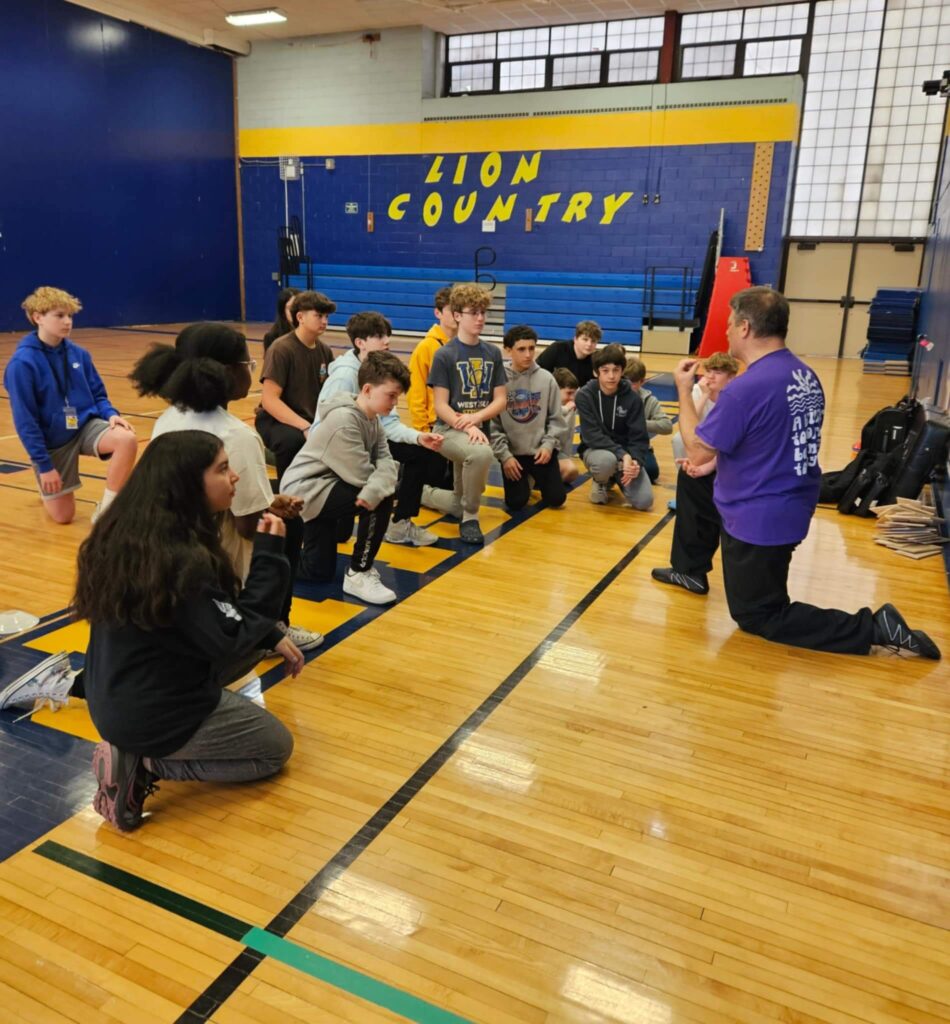
Through a combination of martial arts, neurobics, and motivational speaking, students engaged in an active learning experience designed to cultivate both mental resilience and self-assurance. By integrating movement with cognitive exercises, we reinforced essential skills that support both academic success and personal growth.
The Role of Neurobics in Cognitive and Emotional Development
A core component of our approach is the use of neurobics, a set of cognitive exercises designed to engage multiple neural pathways simultaneously. Neuroscientific research demonstrates that novel and complex movement patterns stimulate brain plasticity, enhance memory retention, and improve overall cognitive function. In our workshop, students practiced a traditional Chinese kung fu form that required them to coordinate precise movements while maintaining awareness of their surroundings. This exercise not only strengthened their ability to focus but also reinforced the importance of mindfulness and spatial awareness.
Neurobics also fosters self-regulation. By engaging in structured, repetitive movement sequences, students developed the ability to sustain attention over time and manage their energy levels effectively. These skills are directly applicable to classroom settings, where students must navigate distractions while maintaining focus on academic tasks.
Confidence as a Learned Behavior
Confidence is often viewed as an inherent trait, but in reality, it is a skill that can be developed through deliberate practice. In our workshop, students were introduced to practical strategies for cultivating confidence, beginning with posture and body language. Research in cognitive psychology indicates that open, upright posture not only influences how others perceive an individual but also impacts the individual’s own self-perception. By adopting strong, expansive stances, students experienced a shift in their internal state, reinforcing feelings of self-assurance and readiness.
Vocal expression also played a key role in this session. Through structured call-and-response exercises, students practiced projecting their voices clearly and assertively. By removing the hesitation often associated with speaking in front of peers, they learned to communicate with conviction. The integration of rhythm, repetition, and even moments of playfulness helped reinforce this practice in a way that was both engaging and effective.
Experiencing Growth Through Challenge
One of the most significant aspects of this student workshop was the opportunity for students to step outside their comfort zones in a supportive environment. Many had never attempted martial arts, practiced mindful movement, or spoken publicly with confidence. Yet, by the end of the session, each student had successfully learned and performed a structured movement sequence, projected their voice without hesitation, and engaged fully in each exercise.
The process of acquiring new skills—particularly those that require both cognitive and physical coordination—fosters a sense of achievement. This incremental progress builds intrinsic motivation, reinforcing the belief that effort leads to improvement. By approaching each challenge with full commitment, students not only developed confidence in the moment but also internalized a mindset that will serve them in future endeavors.
Practical Applications Beyond the Workshop
The principles introduced in this session extend far beyond martial arts or movement-based learning. The ability to maintain focus, project confidence, and regulate one’s own mental and physical state is essential across all areas of education and personal development. These are not abstract concepts but actionable skills that, when practiced consistently, translate into greater academic engagement, improved classroom behavior, and stronger interpersonal interactions.
By integrating cognitive science, physical movement, and behavioral strategies, we provide students with tools that foster long-term growth. As schools continue to seek effective ways to support the well-being and academic success of young learners, a student workshop such as this offers a research-backed approach that aligns with the broader goals of social-emotional learning and student empowerment.
The work of PS I Love You Day serves as an important reminder of the role that supportive communities play in fostering resilience and self-worth. Through structured, intentional experiences, we can equip students with the skills they need to navigate challenges with confidence and clarity.
Author:
Michael A. Evans is a lifelong learner and interdisciplinary educator, coach, and consultant passionate about bridging historical knowledge with modern application in education, leadership, and human development. As the founder of Synchronicity Coaching Inc., he leads training, professional development, and experiential learning initiatives that empower individuals and organizations to cultivate resilience, adaptability, and holistic success. His work spans cognitive science, education, and hands-on skill-building, integrating ancestral knowledge, STEM education, martial arts, and wellness practices to foster critical thinking, problem-solving, and sustainable personal growth. Through Synchronicity Coaching and its specialized programs—Forgotten Skillz, Vision Martial Arts, Ninja Nee, Little Laurie, and Massage LI—he applies a multi-disciplinary, curiosity-driven approach to help individuals and organizations navigate complexity, foster innovation, and thrive in an evolving world.